


Breakdown Cover For New Drivers


Breakdown Cover for New Drivers UK: Which Level Makes Sense for Your First Car?

Breakdown cover is easier to understand if you stop thinking about product names and imagine the car actually stopping. Where are you? Can the car be fixed? Where do you want it taken? And how are you getting home?

This guide is written for newly qualified drivers and first-car owners. It explains the usual cover levels, but more importantly it shows which type of cover makes sense in different real-life situations.

Last reviewed: August 2026
Best First Cars GuideRecommended Products & Services


Breakdown cover decision guide for new drivers

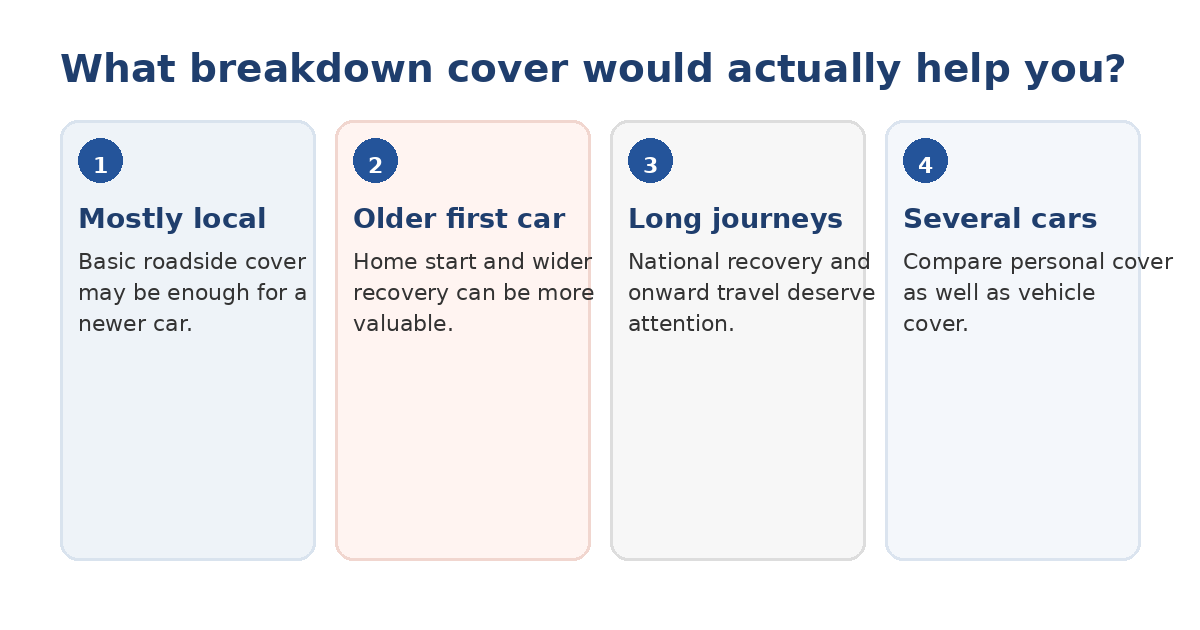
Choose the cover around the journeys you actually make.


My quick answer

If your first car is fairly new, you mainly drive locally and somebody could easily collect you, basic roadside cover may be enough. If you have an older first car, commute long distances, drive on motorways or live away from family, home start, national recovery and onward-travel options become much more valuable.

Before buying anything, also check whether breakdown cover is already included through your car warranty, insurance, bank account or another membership.


What the main types of breakdown cover mean

Roadside assistance normally means a patrol comes to you when you break down away from home, tries to repair the vehicle and tows it to a nearby garage if the repair cannot be completed there.

Home start adds help when the car breaks down at or close to home.

National recovery gives you a wider recovery option if the vehicle cannot be fixed, rather than limiting the tow to a nearby garage.

Onward travel can help you continue the journey through alternatives such as a replacement car, public transport or accommodation, depending on the policy.

Providers define these benefits differently, so compare the actual wording rather than relying on the label alone.


Newer first car + mainly local driving

I would start by pricing basic roadside cover. MoneySavingExpert’s current guidance also notes that basic cover can be sufficient for a newer car where breakdown risk is lower.

Think about: how far from home you normally travel and whether family support is nearby.

Older first car

Home start and wider recovery may be more valuable because a battery, starter, cooling or other age-related issue can leave you stuck before the journey even begins.

Check: vehicle-age limits and any extra call-out charges.

Motorway / university / long-distance driving

National recovery and onward travel become much easier to justify if you could be 100 miles from home when the car stops.

Think about: what would happen to you and your passengers if the car could not be repaired that day.


Scenario: your first car stops 120 miles from home

You are driving home on a Sunday evening and the car will not restart. The patrol cannot repair it at the roadside.

With basic roadside cover, the policy may only provide a local tow. With national recovery, the vehicle may be recoverable much further. With onward travel, the policy may also provide options for you to continue the journey.

Now compare that with a learner whose car is used almost entirely for five-mile trips around home. The same premium package may be far less valuable to them.

This is why the right cover is about the consequence of a breakdown, not simply the age of the driver.


Personal cover or vehicle cover?

Vehicle cover protects a named vehicle, subject to the policy rules. That can be logical when you have one first car.

Personal cover follows the named person in eligible vehicles. That may be more useful if you regularly drive different family cars.

Do not assume personal cover means every person in the household is protected. Read who is actually named and what vehicles qualify.


Before paying, check whether you already have cover

MoneySavingExpert currently recommends checking bank accounts and existing financial products before buying separate breakdown cover because some packaged accounts include it. A new or nearly new car may also include manufacturer assistance.

There is no benefit in paying twice for the same protection.


Older cars can have different rules

Current UK breakdown deals can apply different prices or restrictions to older cars. MoneySavingExpert’s current examples include higher prices or call-out fees on some older vehicles.

Before buying cover for an older first car, check:

  • maximum vehicle age;
  • call-out limits;
  • any excess or call-out fee;
  • pre-existing-fault exclusions;
  • how far the vehicle will be recovered; and
  • when new cover actually starts.


What breakdown cover normally does not solve

Recovery is not the same as repair. If the patrol cannot fix the problem at the roadside, the car may still need diagnostics, parts and garage labour afterwards.

That is where Fast Pass’s existing approved motoring affiliates can become genuinely useful rather than appearing as random advertising.


After recovery: mechanic or garage?

ClickMechanic can be useful if you want to arrange a mobile mechanic or relevant inspection/repair service.

BookMyGarage can be useful for comparing servicing, MOT and garage-booking options.

These are affiliate links. Fast Pass may receive commission from an eligible booking at no extra cost to you.

Check ClickMechanicCompare Garages with BookMyGarage


Do not automatically renew

Breakdown prices and promotions change. Current MoneySavingExpert guidance specifically warns against simply allowing cover to auto-renew without checking the market.

Set a reminder a few weeks before renewal. Compare the same level of cover again rather than comparing a cheap basic policy with a more comprehensive existing one.


The 60-second breakdown-cover test

Before buying, you should be able to answer these in plain English:

Will they come if the car will not start outside my house?

If they cannot fix it, where will they take it?

If I am 150 miles from home, can I get the car home?

What happens to me and my passengers?

How many call-outs are allowed?

Is there an excess, vehicle-age rule or waiting period?

If you cannot answer those questions from the policy information, keep comparing.


Breakdown cover FAQs for new drivers

Do I legally need breakdown cover?

No. Unlike motor insurance, breakdown cover is optional.

Is the cheapest policy good enough for a first car?

It can be if the level of recovery matches your journeys. A cheap policy can be poor value if it leaves you stranded far from home.

Does breakdown cover include repairs?

It normally focuses on roadside assistance and recovery. Garage repairs and replacement parts are usually separate unless a policy specifically includes an additional benefit.

Do I need home start?

It is more valuable if you would struggle to deal with a car that will not start at home. Basic roadside cover can exclude breakdowns at or close to your address.

Should I buy personal or vehicle cover?

Vehicle cover often suits somebody with one first car. Personal cover can become more useful if you regularly travel in or drive several different vehicles.


Buy the recovery outcome you would actually need

Picture one of your normal journeys going wrong, then compare cover that would solve that situation. Do not pay for extras simply because the package name sounds reassuring.

Best First CarsRecommended Products