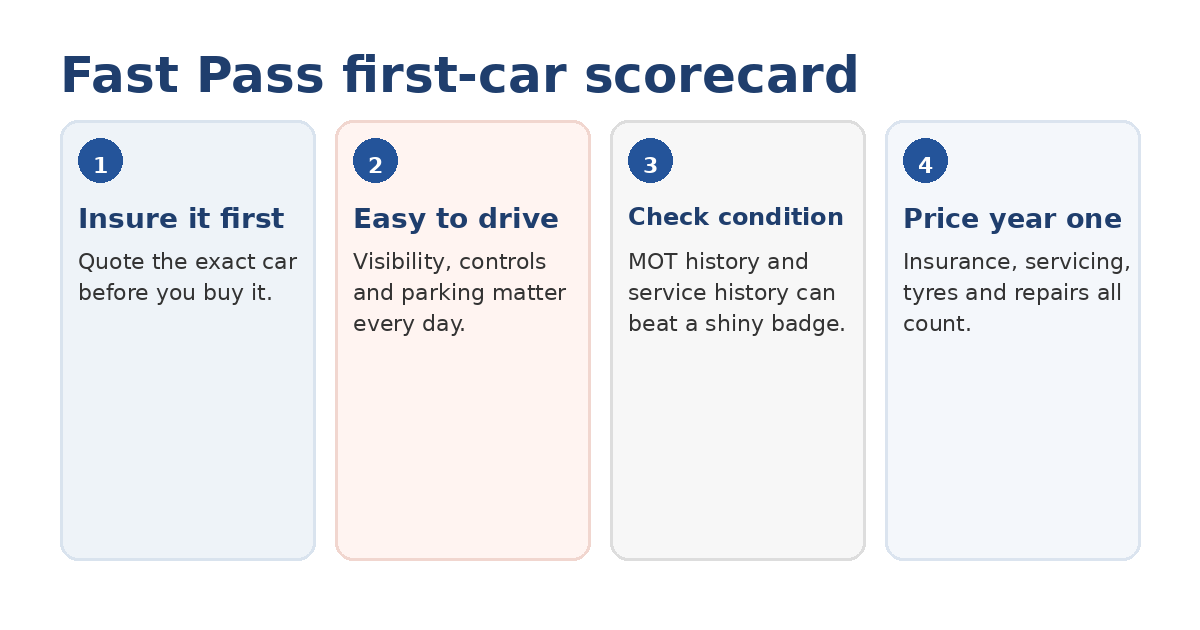


The best first car is affordable to insure, safe, reliable and suitable for the journeys you will actually make.
Compare sensible first-car types, understand the real running costs and check a used vehicle properly before buying.
There is no single best first car for every new driver.
Your choice depends on:
- insurance quotations;
- purchase budget;
- manual or automatic licence;
- annual mileage;
- where the car will be parked;
- passenger and luggage needs;
- fuel or charging access;
- maintenance history;
- safety; and
- the condition of the individual vehicle.
View Suitable First-Car Types
Arrange a Used-Car Inspection
Affiliate disclosure: Some service links on this page are affiliate links. Fast Pass may receive a commission if you make a booking through them, at no additional cost to you.
What makes a good first car?
A strong first-car candidate usually offers:
- reasonable insurance quotes;
- predictable controls;
- good visibility;
- manageable dimensions;
- available replacement parts;
- straightforward servicing;
- sensible tyre sizes;
- good fuel economy or suitable electric range;
- appropriate safety equipment;
- a documented maintenance history; and
- no major hidden faults.
The condition of a specific used vehicle matters more than choosing a supposedly perfect model that has been neglected.
Check insurance before buying
Do not assume that a small engine automatically produces the cheapest insurance.
Quotes can vary according to:
- your age;
- postcode;
- occupation;
- driving history;
- vehicle model and exact version;
- engine and power;
- repair costs;
- security;
- annual mileage;
- where the vehicle is parked;
- named drivers;
- policy type; and
- whether telematics is used.
Obtain genuine quotes for the exact registration or specification before paying a deposit.
Read the young-driver insurance guide
Calculate the full first-year cost
Your budget should include more than the purchase price.
- insurance;
- vehicle tax;
- fuel or electricity;
- MOT;
- servicing;
- tyres;
- repairs;
- breakdown cover;
- parking;
- clean-air or congestion charges where applicable;
- finance interest where relevant; and
- an emergency repair fund.
A cheaper car can become expensive if it requires immediate tyres, brakes, a timing belt or other major work.
Suitable first-car types and examples
The following are common categories and examples worth researching. They are not guarantees that every version will be affordable, safe or reliable.
Small city cars
Examples include:
- Toyota Aygo;
- Citroën C1;
- Peugeot 107 or 108;
- Volkswagen up!;
- Škoda Citigo;
- SEAT Mii;
- Hyundai i10; and
- Kia Picanto.
Potential advantages:
- compact size;
- easy parking;
- small petrol engines;
- often modest fuel use; and
- good availability on the used market.
Potential disadvantages:
- limited rear space;
- smaller boots;
- less relaxed motorway driving;
- older examples may have limited safety equipment; and
- insurance still varies by exact version.
Toyota Aygo, Citroën C1 and Peugeot 107/108
These closely related city cars are common first-car candidates.
Reasons drivers consider them include:
- compact dimensions;
- simple petrol versions;
- good urban visibility;
- shared mechanical components; and
- wide used availability.
Check:
- clutch operation;
- water leaks;
- exhaust condition;
- service history;
- tyres and brakes;
- warning lights; and
- insurance for the exact version.
Volkswagen up!, Škoda Citigo and SEAT Mii
These related models can offer a more substantial small-car feel while remaining compact.
Check:
- clutch and gearbox operation;
- service records;
- water ingress;
- electrical equipment;
- tyre condition;
- accident repairs; and
- whether the exact engine and trim suit your insurance budget.
Hyundai i10 and Kia Picanto
These models are often considered because of their compact size, practical five-door layouts and broad used availability.
Check:
- service history;
- clutch and gearbox;
- steering and suspension noises;
- brakes;
- body condition;
- remaining manufacturer warranty where relevant; and
- insurance for the exact model.
Toyota Yaris and Honda Jazz
These can suit drivers who want more room than a small city car.
Potential strengths include:
- practical interiors;
- good visibility in many versions;
- petrol and hybrid options depending on model year;
- strong owner demand; and
- suitability for mixed urban and longer journeys.
Hybrid versions require insurance and battery-condition considerations, while older examples still need careful checks for rust, servicing and previous repairs.
Ford Fiesta and Vauxhall Corsa
These are widely available and familiar to many garages.
Advantages may include:
- a large choice of used cars;
- available parts;
- good everyday practicality;
- a wide range of engines; and
- easy comparison between several examples.
However, some versions are substantially more expensive to insure than others.
Check:
- the exact engine;
- timing-belt or timing-chain requirements;
- service records;
- clutch operation;
- coolant and oil condition;
- warning lights;
- previous accident damage; and
- insurance before buying.
Suzuki Swift
The Swift may suit drivers wanting a compact hatchback that remains practical for mixed journeys.
Check:
- insurance for the exact version;
- body and underside condition;
- service history;
- clutch operation;
- suspension noises;
- tyres; and
- whether a sportier version would create unnecessary running costs.
Manual or automatic first car?
Manual
Potential advantages:
- more choice in the lower-cost used market;
- often simpler and cheaper transmissions;
- you retain manual-driving experience; and
- some small manual cars are economical to run.
Automatic
Potential advantages:
- easier driving in congestion;
- no clutch pedal;
- useful for drivers with an automatic-only licence;
- hybrid and electric options; and
- less concern about clutch wear caused by poor technique.
Automatic gearboxes vary considerably. A traditional automatic, automated manual, dual-clutch gearbox and CVT can have different driving characteristics and repair risks.
Research the exact transmission rather than relying on the word “automatic”.
Petrol, diesel, hybrid or electric?
Petrol
Often suitable for:
- lower annual mileage;
- urban and mixed journeys;
- drivers wanting broad used choice; and
- simpler small-car options.
Diesel
May suit regular longer journeys, but an older diesel can be a poor choice for repeated short trips.
Consider:
- diesel particulate-filter requirements;
- clean-air-zone compliance;
- higher repair costs for some systems;
- insurance;
- annual mileage; and
- the type of journeys you make.
Hybrid
Can suit urban and mixed driving, but check:
- battery condition;
- manufacturer warranty;
- service history;
- insurance;
- repair expertise; and
- the exact hybrid type.
Electric
Can offer smooth automatic driving and lower home-charging costs where suitable.
Check:
- realistic range;
- battery health;
- home or local charging;
- insurance;
- rapid-charging capability;
- charging-cable inclusion;
- manufacturer battery warranty;
- cold-weather range; and
- tyre and repair costs.
How to check an electric-car battery
Before buying a used electric vehicle:
- ask for a battery-health report where available;
- check the displayed range after a full charge;
- compare it with age and model expectations;
- review charging history where possible;
- confirm the remaining battery warranty;
- test both AC and rapid charging where practical;
- check the charging port and cables;
- look for warning messages; and
- use a specialist inspection where needed.
Do not rely only on the range displayed during a short test drive.
Safety ratings
Euro NCAP provides independent safety assessments, but ratings must be interpreted carefully.
Check:
- the exact model generation;
- the year it was tested;
- whether the rating applies to the UK version;
- standard versus optional safety equipment;
- adult-occupant protection;
- child-occupant protection;
- vulnerable-road-user protection; and
- safety-assistance performance.
Testing becomes more demanding over time, so star ratings from different years should not be compared as though they used identical standards.
Search Euro NCAP safety ratings
Check the MOT history
The MOT history can reveal:
- recorded mileage;
- previous failures;
- recurring advisories;
- tyre concerns;
- corrosion;
- brake issues;
- suspension wear;
- lighting faults; and
- how consistently the vehicle was presented for testing.
An MOT history does not show every repair or guarantee the current condition.
Check the vehicle’s MOT history
Check the documents and identity
Before paying:
- inspect the V5C log book;
- confirm the registration;
- check the make and model;
- match the VIN to the vehicle;
- check the engine details where relevant;
- check the seller’s identity and address;
- review service invoices;
- check outstanding finance;
- check whether it has been recorded as stolen or written off; and
- make sure the seller has the right to sell it.
Follow the official used-car checks
Arrange an independent inspection
An inspection may help where:
- you do not have mechanical experience;
- the car is being sold privately;
- the service history is incomplete;
- the vehicle is older;
- you noticed noises or warning lights;
- the car has visible body repairs; or
- the purchase represents a large part of your savings.
View ClickMechanic Used-Car Inspections
Test-drive checklist
During a safe and properly insured test drive, check:
- cold starting;
- warning lights;
- steering;
- brakes;
- clutch and gearbox;
- automatic transmission behaviour;
- suspension noises;
- engine temperature;
- acceleration;
- visibility;
- seat comfort;
- air conditioning and heating;
- wipers and washers;
- electrical equipment; and
- whether the car suits normal journeys.
Do not test-drive a vehicle unless you are legally licensed and properly insured.
After buying the car
Arrange:
- insurance before driving;
- vehicle tax;
- any immediate servicing;
- replacement of unsafe tyres or brakes;
- manufacturer recalls;
- a spare key where necessary;
- breakdown cover;
- the correct handbook and service schedule;
- a dash cam where desired; and
- a maintenance budget.
Compare servicing and MOT options through BookMyGarage
Best First Cars FAQs
What is the best first car?
The best choice depends on insurance, budget, condition, reliability, safety and the journeys you will make.
Is a one-litre engine always cheapest to insure?
No. Insurance depends on the exact vehicle version and personal risk details, not engine size alone.
Should I buy manual or automatic?
Choose according to your licence, budget, traffic conditions and the reliability and cost of the exact transmission.
Are electric cars suitable for new drivers?
They can be, particularly where home charging and insurance are affordable. Check battery health, range and repair costs.
Is an MOT enough to prove a car is good?
No. An MOT is not a mechanical warranty or full vehicle inspection.
Should I arrange an inspection?
It can be worthwhile where you lack mechanical knowledge or are spending a substantial amount on an older used car.
Which first cars are cheap to insure?
This varies between drivers and exact versions. Obtain quotes before buying rather than relying on a generic list.
Are the inspection links affiliate links?
Yes. Fast Pass may receive commission at no additional cost to you.
Buy the individual car, not just the model name
A well-maintained example with good history and suitable insurance is normally a better first car than a neglected example of a model that appears on every recommendation list.