

Driving Test Day Tips


Driving Test Day Tips: How to Give Yourself the Best Chance of Driving Normally

On test day, the aim is not to become a better driver in the final hour. It is to make the day simple enough that the safe driving you already know how to do can actually come out.

I have been teaching learners since 2004, and one of the biggest problems on test day is people trying to do something special because an examiner is sitting beside them. You do not need special driving. You need your normal good driving.

Last reviewed: August 2026
Driving Test ChecklistHow to Pass Your Test


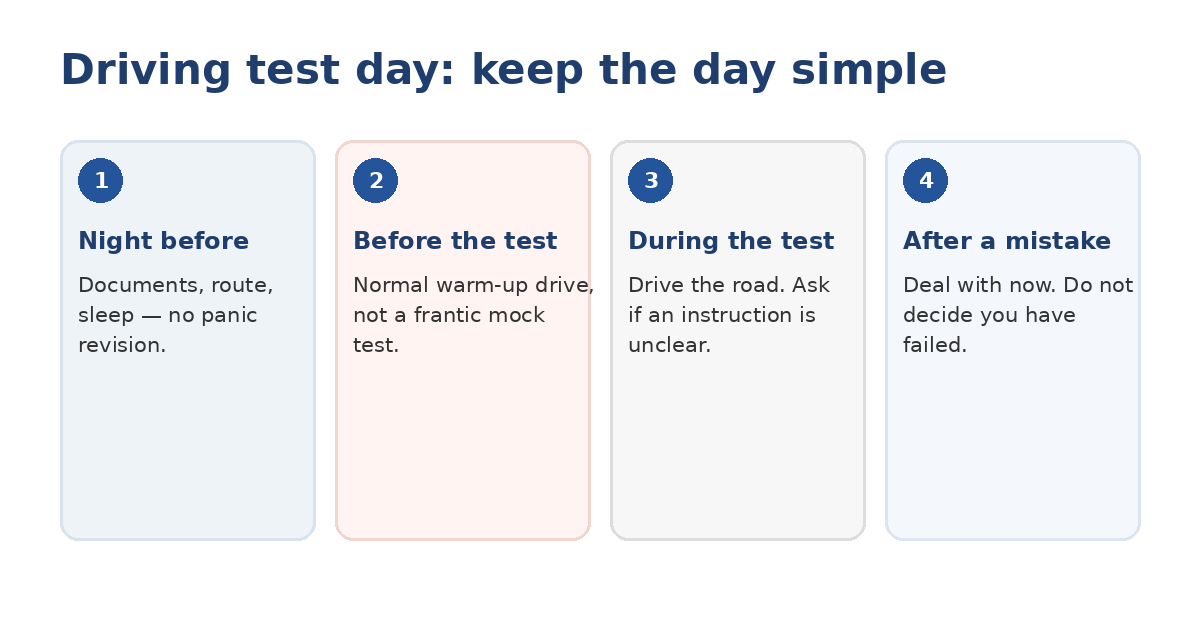
Fast Pass driving test day preparation plan

The best test-day plan reduces unnecessary decisions and pressure.


The night before: make tomorrow boring

Check your photocard licence, glasses or contact lenses if you need them, the test-centre details and how you are getting there. Then stop trying to learn everything at once.

A late-night attempt to memorise routes, manoeuvres and every possible fault is more likely to make you tired and self-conscious than suddenly improve your driving.


What I would do in the hour before the test

Use the drive to the centre to settle into normal driving. Check the controls you may be asked about, get comfortable in the seat and let your observations return to their usual rhythm.

I would not turn the final hour into a frantic mock test unless there is a very specific reason. The aim is to arrive alert, familiar with the car and mentally settled.


When the examiner gives you an instruction

Listen to the whole instruction and keep driving the road while you process it. If you did not hear or understand, ask for it to be repeated.

If you end up in the wrong lane or miss the turn, continue safely. A wrong direction is not automatically a fail; an unsafe late lane change can be.


If you make a mistake, do not mark your own test

This is one of the most useful things to remember. Learners often make a small mistake, decide internally that they have failed, and then spend the next five minutes thinking about the result rather than the road.

Deal with what is happening now. If the mistake was minor, the test may still be going perfectly well. If it was serious, replaying it in your head cannot change it anyway.


A simple reset after a mistake

Road. What is happening directly ahead?

Mirrors. What is around me?

Next decision. What does this road need from me now?

That is enough. You do not need an elaborate breathing ritual while the car is moving.


Do not let another driver take your test for you

A driver sitting close behind does not get to choose your speed, gap at a junction or whether you rush a manoeuvre. Make the safe decision based on what you can see.

Equally, safe does not mean excessively hesitant. If there is a clear safe opportunity and you understand it, take it.


Route videos and local knowledge

Knowing the local road environment can be useful, but trying to predict every turn can steal attention from the road. Use route videos to practise observation, lane planning and hazard recognition — not as a script for the examiner.

That is the same approach used on our Anniesland and Baillieston test-centre guides.


If nerves are the real problem

Nerves do not automatically mean you are unready. The question is whether you can still observe, plan and make safe decisions while feeling nervous.

If nerves repeatedly make you miss obvious hazards or need instructor intervention, more mock-test exposure may help. If you can still drive independently, feeling nervous on the day is not evidence that you cannot pass.


After the test

If you pass, listen to the feedback anyway. Passing is the start of independent driving, not the end of learning.

If you do not pass, use the recorded faults to build the next practice plan. Do not simply book another test and hope the same weaknesses disappear on their own.

Common Driving Test Faults


Driving test day FAQs

Should I have a lesson immediately before the test?

A sensible warm-up is common, but it should help you settle rather than exhaust you.

Can I ask the examiner to repeat a direction?

Yes. Ask if you did not hear or understand it.

Does going the wrong way mean I fail?

No. Continue safely instead of making an unsafe correction.

What should I do after a mistake?

Deal with the current road situation and bring your attention back to the next decision.


Drive the road, not the result

Your job is to make one safe decision at a time. The examiner will deal with the result at the end.

Driving Test ChecklistHow to Pass Your Test