

The best dash cam is one that records clearly, works reliably and does not obstruct your view.
Learn which features matter for a learner, newly qualified driver or first-car owner before paying for specifications you may not need.
A dash cam can provide footage of a journey or road incident, but different drivers need different systems.
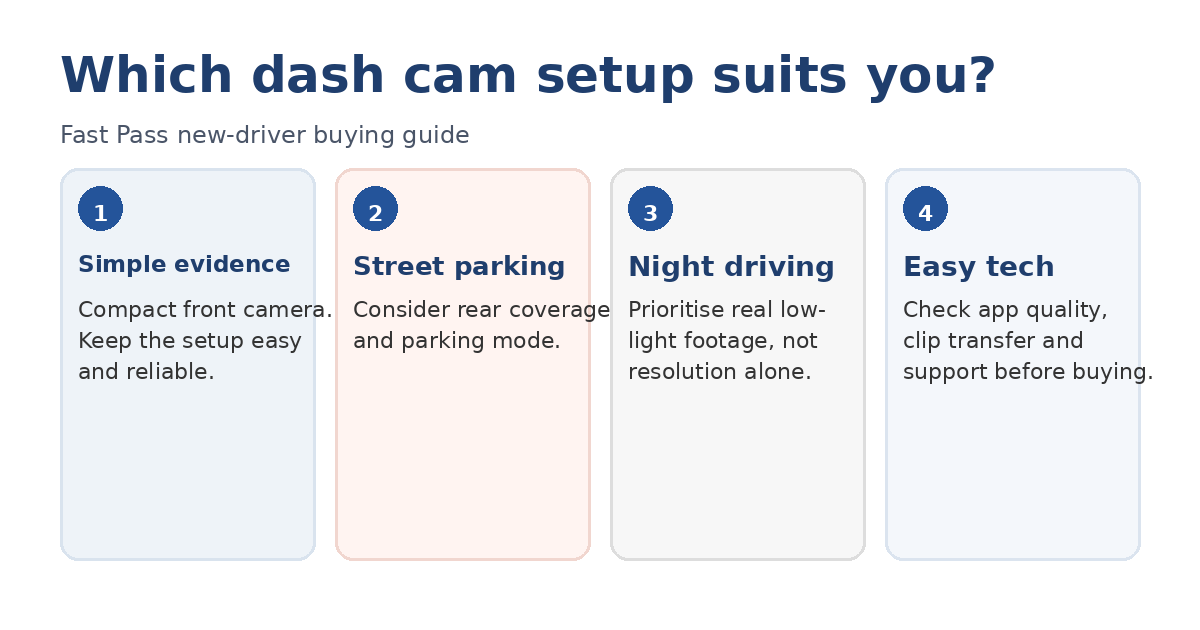
Before buying, decide whether you need:
- a simple front-facing camera;
- front-and-rear coverage;
- parking protection;
- GPS and speed data;
- easy mobile-phone transfer;
- high-resolution footage;
- a compact camera; or
- professional hardwiring.
View Nextbase Dash Cams
Read the Buying Guide
Affiliate disclosure: The Nextbase links on this page are affiliate links. Fast Pass may earn a commission if you purchase through them, at no additional cost to you.
Our overall recommendation
For many new drivers, a mid-range front-facing dash cam from an established manufacturer provides the best balance of:
- clear footage;
- reliable operation;
- simple installation;
- mobile connectivity;
- support and firmware updates;
- replacement mounts and cables;
- memory-card guidance; and
- reasonable cost.
Front-and-rear recording is worth considering where the budget allows, particularly for drivers who regularly park on the street or want coverage of rear impacts.
Recommended Nextbase range
Nextbase offers cameras ranging from compact entry-level units to higher-resolution and connected systems.
Rather than naming one permanent “best” model, choose according to your needs because prices, bundles and available models can change.
Best for basic front recording
Look for:
- at least Full HD recording;
- a compact mount;
- automatic recording when the car starts;
- loop recording;
- incident-file protection; and
- support for a dash-cam-compatible memory card.
Best for everyday new drivers
A mid-range model may add:
- GPS;
- Wi-Fi or Bluetooth;
- mobile-app footage transfer;
- improved night footage;
- parking mode; and
- emergency features.
Best for maximum detail
A higher-resolution camera may help retain more visual detail, but it usually:
- costs more;
- creates larger files;
- needs a suitable faster memory card;
- may require more frequent file management; and
- does not guarantee that every number plate will be readable in every condition.
Compare the Current Nextbase Range
Front-only or front-and-rear?
Front-only camera
Advantages:
- lower cost;
- simpler fitting;
- fewer cables;
- less memory usage; and
- covers many incidents occurring ahead.
Front-and-rear camera
Advantages:
- records impacts from behind;
- adds context to incidents;
- can record vehicles following dangerously;
- may be useful when parked; and
- provides broader evidence.
The rear camera adds cost and installation complexity. Check whether it records through the rear window or requires an exterior installation.
What video resolution do you need?
Common advertised resolutions include:
- 1080p Full HD;
- 1440p or 2K;
- higher-resolution 4K recording; and
- different frame-rate combinations.
Resolution is only one part of image quality.
Also consider:
- lens quality;
- sensor performance;
- night-time exposure;
- movement;
- weather;
- compression;
- windscreen cleanliness;
- camera position; and
- the relative speed of another vehicle.
Night-time recording
New drivers may regularly drive after dark during winter.
Good night footage should manage:
- headlight glare;
- street lighting;
- dark rural roads;
- reflective number plates;
- rain on the windscreen; and
- rapid changes between bright and dark areas.
No consumer dash cam can guarantee perfectly readable footage in every night-time situation.
Parking mode
Parking mode is intended to record or save footage when the vehicle is parked and the camera detects movement or impact.
Check:
- whether parking mode is included;
- whether hardwiring is required;
- how the camera protects the car battery;
- how long the feature can remain active;
- whether recordings are buffered;
- whether rear coverage is included; and
- how easily parking files can be found.
Parking mode cannot prevent theft or damage, and the camera itself may be visible to a thief.
GPS and speed information
GPS can record information such as location and vehicle speed alongside footage.
This may help explain where and when an event occurred.
Before sharing footage:
- review what information is included;
- keep the original file where evidence may be needed;
- do not edit footage in a misleading way;
- avoid publishing identifiable footage unnecessarily; and
- provide complete information to an insurer or police where requested.
Wi-Fi, Bluetooth and mobile apps
Wireless connectivity can make it easier to:
- view footage;
- download a clip;
- change settings;
- check the camera angle;
- update firmware; and
- share evidence.
Set up the app while parked. Do not handle the phone while driving.
Choosing a memory card
Dash cams repeatedly write and overwrite video files, which can place heavy demands on a memory card.
Use:
- a card type approved for the camera;
- the supported capacity;
- a suitable speed rating;
- a high-endurance card where recommended; and
- a reputable manufacturer.
Check the camera periodically and format the card according to the manufacturer’s instructions.
A camera with a failed or incompatible card may appear powered on without recording usable footage.
Hardwired or plugged into a socket?
Plug-in installation
- usually simpler;
- easier to move between vehicles;
- may occupy the accessory socket;
- can leave visible cables; and
- may limit parking-mode operation.
Hardwired installation
- can look tidier;
- may enable parking mode;
- keeps the accessory socket free;
- requires the correct fitting kit; and
- should avoid airbags and existing wiring.
Use a competent fitter where you are uncertain about the vehicle’s electrical system.
Where should a dash cam be mounted?
The camera must not seriously obstruct your view of the road.
A suitable position is often:
- high on the windscreen;
- close to or behind the interior mirror;
- within the area swept by the wipers;
- outside the main field of vision;
- away from sensors and cameras already fitted to the car; and
- where the lens has an unobstructed view.
Check the camera view from the driver’s seat and in recorded footage.
Read the government windscreen-obstruction guidance
Do dash cams reduce insurance prices?
Some insurers may consider a dash cam or offer a specific arrangement, but a camera does not automatically reduce every new driver’s premium.
Insurance pricing can depend on:
- age and experience;
- postcode;
- vehicle;
- annual mileage;
- occupation;
- where the car is kept;
- claims history;
- named drivers;
- policy type; and
- telematics requirements.
Ask the insurer directly rather than assuming that buying a camera will pay for itself through a discount.
Using footage after an incident
After an incident:
- make sure everyone is safe;
- contact emergency services where necessary;
- exchange required details;
- protect the relevant recording;
- avoid overwriting the file;
- keep the original recording;
- tell your insurer footage exists; and
- provide it to police or insurers where appropriate.
Do not post footage publicly before considering privacy, legal and insurance consequences.
Is a cheaper dash cam good enough?
A basic camera may be enough where you only need reliable front recording.
Before buying a very cheap model, check:
- real recorded footage rather than only specifications;
- night-time quality;
- memory-card compatibility;
- mount stability;
- firmware and support;
- warranty;
- replacement cable availability; and
- whether footage can be exported easily.
A camera is poor value if it fails to record when needed.
Our recommendation for most new drivers
Choose a compact front-facing or front-and-rear Nextbase system with:
- clear Full HD or better recording;
- simple automatic operation;
- a supported high-endurance memory card;
- reliable mounting;
- parking mode where needed;
- mobile transfer if you will use it; and
- professional installation where hardwiring is unfamiliar.
View Current Nextbase Cameras and Bundles
Dash Cam FAQs
Are dash cams legal in the UK?
Dash cams can be used, but they must be positioned safely and must not seriously obstruct the driver’s view.
Should a new driver buy front-and-rear cameras?
Rear coverage can provide useful additional footage, but it costs more and requires more installation work.
Is 4K necessary?
No. A reliable Full HD or 2K camera may be sufficient. Resolution alone does not determine footage quality.
Do I need parking mode?
It may be useful for street or public parking, but it may require hardwiring and cannot prevent damage or theft.
Can I use a normal memory card?
Use a card that meets the camera manufacturer’s required capacity, speed and endurance specification.
Will a dash cam lower my insurance?
Not automatically. Ask insurers whether a camera affects their quote or policy terms.
Where should it be mounted?
Usually high on the windscreen and outside the main field of vision, while remaining within the wiper-cleared area.
Are the Nextbase links affiliate links?
Yes. Fast Pass may receive a commission at no extra cost to you.
Choose reliability over headline specifications
A correctly positioned camera with a compatible memory card and clear usable footage is more valuable than an unreliable camera advertising features you do not need.