

Breakdown Cover For New Drivers

Breakdown cover can help when your first car cannot continue safely, but policies vary widely.

Compare roadside assistance, home start, recovery distance, onward travel, vehicle restrictions and the full renewal cost.

The cheapest policy may provide only basic roadside assistance.

Before buying, decide whether you need help:

  • at the roadside;
  • at or near home;
  • recovering the vehicle locally;
  • recovering it anywhere in the UK;
  • continuing your journey;
  • travelling in Europe;
  • covering one vehicle; or
  • covering you in different vehicles.

Use the Breakdown Checklist
View New-Driver Resources

Important: Breakdown cover usually pays for assistance or recovery under stated conditions. It does not necessarily pay for replacement parts or the full repair.

What is breakdown cover?

Breakdown cover provides access to assistance when an eligible vehicle becomes immobilised or unsafe to continue.

Depending on the policy, the provider may:

  • attempt a roadside repair;
  • tow the vehicle to a nearby garage;
  • recover the vehicle further away;
  • help at home;
  • arrange onward travel;
  • provide accommodation;
  • provide a replacement vehicle; or
  • assist during European travel.

Roadside assistance

Basic cover normally begins after the vehicle breaks down away from home.

Check:

  • the minimum distance from home;
  • how long the patrol will attempt repair;
  • where the vehicle will be taken if repair is impossible;
  • the maximum local recovery distance;
  • whether passengers are transported;
  • which roads and locations are covered;
  • whether trailers are included; and
  • what counts as a breakdown.

Home-start cover

Home assistance can help where the vehicle:

  • does not start on your driveway;
  • breaks down close to home;
  • has a flat battery;
  • has an electrical problem;
  • has a tyre issue; or
  • cannot safely begin the journey.

Check the policy’s definition of “home” and the distance covered around it.

Local recovery

Basic roadside policies may tow the vehicle only to:

  • a nearby garage;
  • a destination within a fixed mileage;
  • a repairer chosen by the provider; or
  • the nearest suitable repair facility.

This may be enough for mainly local driving but may not suit regular long journeys.

National recovery

National recovery may transport:

  • the vehicle;
  • the driver; and
  • eligible passengers

to an agreed destination when roadside repair is not possible.

Check:

  • the destination choices;
  • passenger limits;
  • whether animals are transported;
  • whether the vehicle can be taken home;
  • whether the journey must be completed in one stage; and
  • what happens outside normal garage hours.

Onward travel

Onward-travel cover may provide one or more of:

  • a replacement vehicle;
  • public-transport costs;
  • taxi costs;
  • hotel accommodation;
  • transport home; or
  • help reaching the planned destination.

Check:

  • spending limits;
  • number of nights;
  • replacement-car age requirements;
  • licence restrictions;
  • deposit requirements;
  • fuel charges;
  • availability; and
  • whether receipts are required.

New-driver replacement-car restrictions

A replacement or hire vehicle may not be available to every newly qualified driver.

Restrictions can involve:

  • minimum age;
  • minimum licence-holding period;
  • deposit or credit-card requirements;
  • insurance acceptance;
  • penalty points;
  • vehicle availability;
  • manual or automatic transmission; and
  • hire-company conditions.

Do not buy onward-travel cover assuming a hire car is guaranteed.

Vehicle cover versus personal cover

Vehicle cover

Vehicle cover normally applies to one named vehicle, whoever is driving it within the policy conditions.

Personal cover

Personal cover normally follows the named person when driving or travelling in eligible vehicles.

Check whether personal cover includes:

  • driving;
  • travelling as a passenger;
  • vehicles owned by others;
  • motorcycles;
  • commercial vehicles;
  • cars above a certain age; and
  • vehicles above stated size or weight limits.

Check whether cover already exists

Breakdown assistance may already be included with:

  • car insurance;
  • a packaged bank account;
  • a vehicle warranty;
  • a manufacturer plan;
  • a finance agreement;
  • a lease;
  • a dealership package; or
  • a family membership.

Compare the existing cover before paying twice.

Breakdown cover is not a repair warranty

A breakdown provider may charge separately for:

  • replacement parts;
  • batteries;
  • tyres;
  • fuel;
  • specialist recovery;
  • garage labour;
  • diagnostic work;
  • storage;
  • vehicle disposal; and
  • repairs after recovery.

Read the policy wording to understand what assistance is paid for and what remains your responsibility.

Vehicle-age limits

Some policies:

  • exclude older vehicles;
  • charge more for older vehicles;
  • restrict European cover;
  • reduce onward-travel benefits;
  • exclude pre-existing faults; or
  • require the vehicle to be serviced and roadworthy.

Enter the vehicle age and registration accurately.

Pre-existing faults

Cover may not apply where:

  • the fault existed before the policy began;
  • a warning light was ignored;
  • a previous patrol advised repair;
  • the same fault repeatedly occurs;
  • the car was already undriveable;
  • maintenance was neglected; or
  • the policy was purchased after the breakdown.

Do not wait until the vehicle has failed before checking whether immediate cover is permitted.

Excess-based breakdown policies

Some lower-cost policies require you to pay an excess each time assistance is used.

Compare:

  • the annual membership price;
  • the call-out excess;
  • the number of permitted call-outs;
  • recovery charges;
  • parts charges;
  • administration fees; and
  • the likely total cost after one or more incidents.

Pay-and-claim policies

Some providers may require you to:

  1. contact an approved assistance service;
  2. pay some or all of the cost;
  3. obtain evidence and receipts;
  4. submit a claim; and
  5. wait for reimbursement.

Check:

  • approval requirements;
  • claim limits;
  • required evidence;
  • reimbursement times;
  • excluded costs; and
  • whether you can afford the initial payment.

Number of call-outs

Policies may restrict:

  • the number of call-outs per year;
  • repeat faults;
  • call-outs within the first days of cover;
  • the number of vehicles;
  • misfuelling incidents;
  • flat batteries;
  • lost keys;
  • punctures; and
  • non-mechanical assistance.

Flat batteries

Battery problems are common, especially where:

  • the vehicle is used for short journeys;
  • it is left unused;
  • lights or accessories are left on;
  • the battery is old;
  • cold weather reduces performance; or
  • there is a charging-system fault.

Check whether the provider:

  • tests the battery;
  • provides a jump start;
  • sells replacement batteries;
  • fits them roadside; and
  • charges separately for the battery.

Tyres and punctures

Cover may depend on:

  • having a usable spare wheel;
  • having a manufacturer repair kit;
  • having the locking-wheel-nut key;
  • the tyre being repairable;
  • the wheels not being damaged;
  • the location being safe for assistance; and
  • specialist recovery being available.

The replacement tyre itself is normally your cost unless a separate tyre policy applies.

Misfuelling

Some policies include misfuelling assistance while others exclude it or charge separately.

If you put the wrong fuel in the car:

  • do not start the engine;
  • switch off safely if already running;
  • tell the provider exactly what happened; and
  • follow professional instructions.

Lost or locked-in keys

Check whether the policy covers:

  • keys locked inside the vehicle;
  • lost keys;
  • broken keys;
  • key programming;
  • replacement locks;
  • transport to collect a spare key; and
  • damage caused during entry.

Accidents are different from breakdowns

Ordinary breakdown cover may exclude collision recovery.

After a crash, assistance may instead be arranged through:

  • the police;
  • your motor insurer;
  • an accident-recovery service;
  • the road operator; or
  • a separately charged recovery company.

Check whether accident recovery is included and whether costs are recoverable through insurance.

European breakdown cover

Before travelling abroad, check:

  • countries covered;
  • trip-duration limits;
  • annual travel limits;
  • vehicle-age restrictions;
  • repatriation limits;
  • labour and parts limits;
  • replacement-vehicle conditions;
  • accommodation limits;
  • translation assistance;
  • documents required; and
  • whether cover must be purchased before leaving the UK.

Response times

Providers may publish average response information, but an individual wait can depend on:

  • location;
  • weather;
  • traffic;
  • demand;
  • road closures;
  • vehicle type;
  • safety priority;
  • specialist equipment; and
  • patrol availability.

No provider can guarantee the same arrival time in every situation.

What to do after breaking down

Where possible:

  • move the vehicle to a safe place;
  • switch on hazard lights;
  • use sidelights in poor visibility;
  • exit safely away from traffic where appropriate;
  • keep passengers safe;
  • do not stand between the vehicle and moving traffic;
  • give the provider an accurate location;
  • describe warning lights or symptoms;
  • tell them about vulnerable passengers; and
  • call emergency services where there is immediate danger.

Motorways require particular care. Follow current official safety guidance.

Read the Highway Code breakdown guidance

Renewal pricing

Introductory breakdown prices may increase at renewal.

Before renewing:

  • check the new annual price;
  • compare the same cover level elsewhere;
  • check changes to excesses;
  • review vehicle details;
  • remove duplicated benefits;
  • check payment charges;
  • review cancellation terms; and
  • confirm whether you still need every feature.

Breakdown-cover comparison checklist

  • Is this vehicle or personal cover?
  • Is roadside assistance included?
  • What is the minimum distance from home?
  • Is home start included?
  • How far will the vehicle be recovered?
  • Can it be recovered to my chosen destination?
  • Are passengers transported?
  • Is onward travel included?
  • Could I meet the hire-car restrictions?
  • Are hotel or public-transport costs included?
  • How many call-outs are permitted?
  • Are repeat faults excluded?
  • Is there a call-out excess?
  • Is this a pay-and-claim policy?
  • Are older vehicles accepted?
  • Are batteries, tyres and keys covered?
  • Is misfuelling included?
  • Is accident recovery included?
  • Is European cover required?
  • What is the renewal price?

Reduce the chance of a breakdown

  • Service the car at suitable intervals.
  • Check oil and coolant.
  • Check tyre pressure and condition.
  • Respond to warning lights.
  • Maintain the battery.
  • Keep sufficient fuel or charge.
  • Replace worn wipers.
  • Check lights.
  • Listen for unusual noises.
  • Deal with fluid leaks.
  • Keep the locking-wheel-nut key accessible.
  • Carry the correct charging equipment where relevant.

Compare local garages with BookMyGarage

Request mobile-mechanic help through ClickMechanic

Affiliate disclosure: Fast Pass may receive a commission from an eligible booking made through these links. This does not normally increase the price you pay.

Breakdown Cover FAQs

Is breakdown cover legally required?

No, but it can provide assistance and recovery when the vehicle cannot continue safely.

Does breakdown cover pay for repairs?

Not necessarily. Assistance and recovery may be included while parts, garage labour and repairs remain your responsibility.

What is home-start cover?

It covers eligible breakdowns at or within a stated distance of your home.

What is national recovery?

It may transport the vehicle, driver and eligible passengers to an agreed destination when roadside repair is impossible.

Will a new driver receive a replacement car?

Not always. Age, licence, deposit, insurance and hire-company restrictions may apply.

Is breakdown cover already included in car insurance?

Sometimes. Check your insurance, bank account, warranty, finance agreement and manufacturer package before buying duplicate cover.

Will a puncture be covered?

It depends on the policy and whether the vehicle has a suitable spare wheel or repair kit.

Should I compare renewal prices?

Yes. Introductory prices and renewal prices can differ significantly.

Choose cover for the journeys you actually make

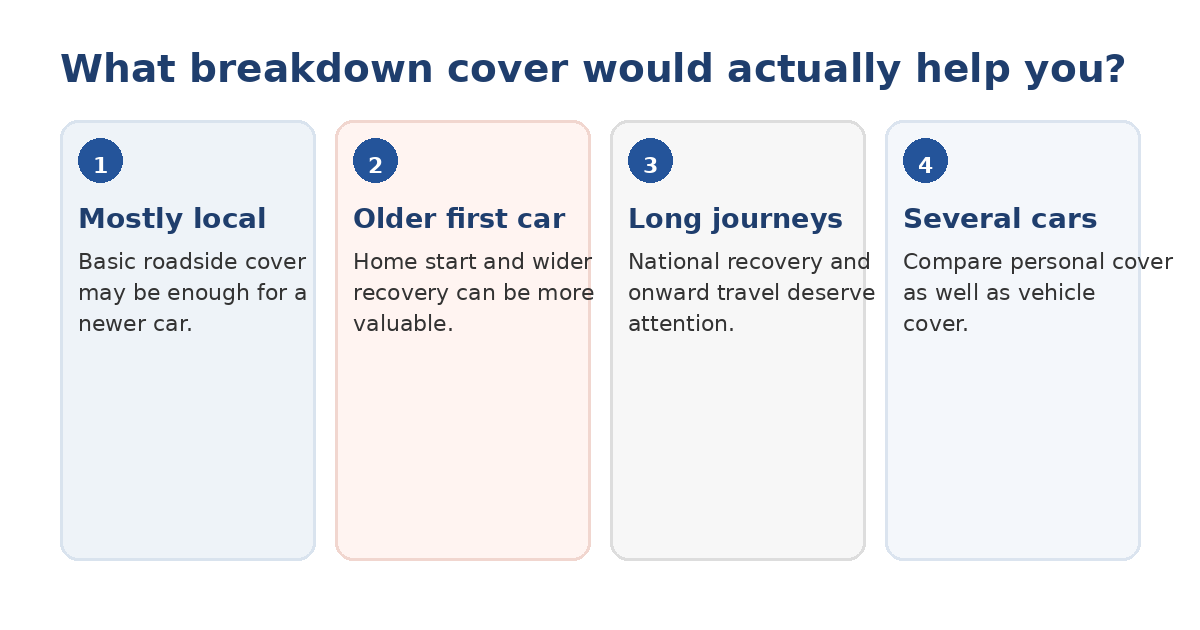
Basic roadside assistance may suit local travel, while regular long-distance journeys may justify national recovery and onward-travel benefits.

Fast Pass Glasgow reviews

Fast Pass has supported learner and newly qualified drivers since 2007.

Glasgow Driving Lessons
Intensive Driving Courses
become a Driving Instructor