

Driving Test Day Tips

# Driving Test Day Tips

Your driving test day can feel exciting, stressful and important all at the same time. That is completely normal. The good news is that with the right preparation, you can feel calmer and more in control when the day arrives.

At Fast Pass Glasgow, we help learner drivers prepare for practical driving tests across Glasgow and nearby areas. Whether your test is at Bishopbriggs, Anniesland, Baillieston or another local test centre, the same goal applies: drive safely, stay calm and show that you can make good decisions independently.

This guide explains what to expect on driving test day, how to prepare, what to avoid and how to stay focused if nerves start to build.

[vc_btn title=”Book Driving Test Preparation” style=”custom” custom_background=”#c8102e” custom_text=”#ffffff” shape=”rounded” size=”md” align=”left” link=”url:/contact/|title:Book Driving Test Preparation”]

## Before Your Driving Test Day

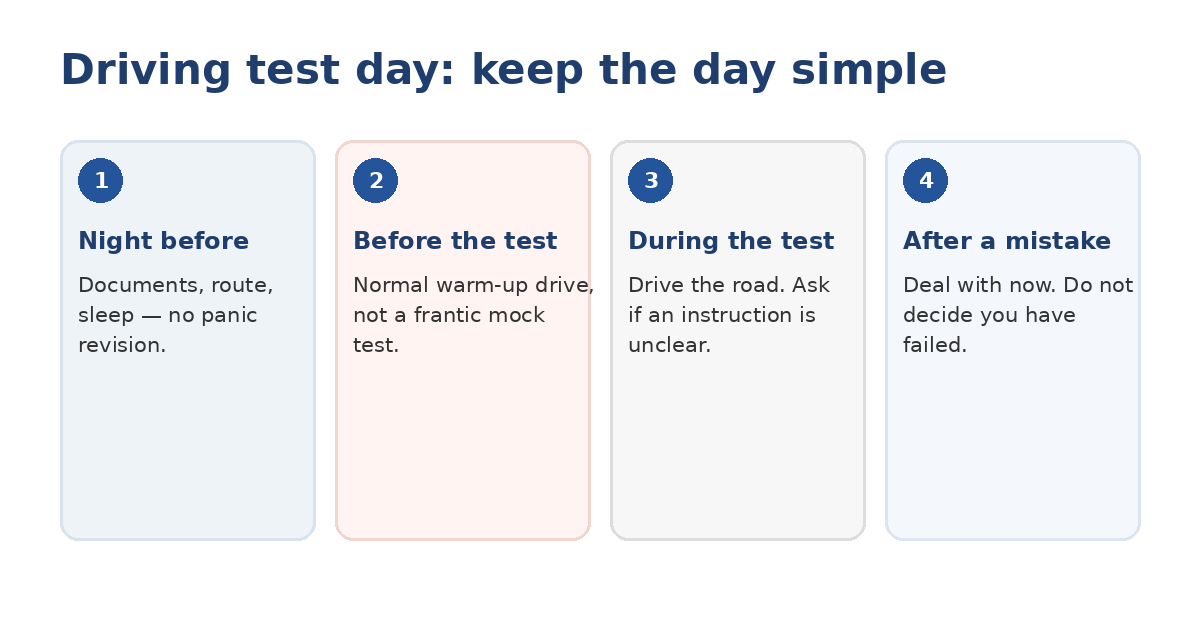
Good test day preparation starts before the day itself. If you leave everything until the last minute, nerves can feel worse.

In the days before your test, make sure you:

* Know the date and time of your test
* Know which test centre you are going to
* Have your provisional licence ready
* Check your lesson and test arrangements with your instructor
* Get enough sleep the night before
* Avoid trying to learn too much at the last minute
* Review any common faults you have been working on
* Ask your instructor about anything you are unsure of

Your final lessons should focus on consistency. This is not the time to panic or completely change how you drive. It is the time to sharpen your observations, planning, judgement and confidence.

If there are still areas that feel weak, talk to your instructor early. Focused practice can help you feel more prepared before test day.

[vc_btn title=”Common Driving Test Faults” style=”custom” custom_background=”#c8102e” custom_text=”#ffffff” shape=”rounded” size=”md” align=”left” link=”url:/common-driving-test-faults/|title:Common Driving Test Faults”]

## On The Morning Of Your Driving Test

Try to keep the morning of your driving test simple and calm. You do not need to treat it like a normal day, but you also do not want to build it up too much in your head.

Helpful test morning tips include:

* Eat something light if you can
* Give yourself enough time
* Wear comfortable shoes
* Bring your provisional licence
* Avoid too much caffeine if it makes you shaky
* Do not overthink previous mistakes
* Listen carefully to your instructor
* Focus on safe driving, not perfection

Most learners have a short lesson before the test. This can help you settle into the car, warm up your driving and remind yourself of the basics.

Use that time wisely. You do not need to drive perfectly in the warm-up lesson. The aim is to get comfortable, focus your mind and feel ready to start the test.

## What Happens During The Driving Test?

Your practical driving test is designed to check that you can drive safely and independently. The examiner is not trying to trick you. They are looking for safe decisions, good control and awareness of what is happening around you.

During the test, you can usually expect:

* An eyesight check
* A show me or tell me vehicle safety question
* General road driving
* Independent driving
* One reversing manoeuvre
* Possibly an emergency stop
* Directions from the examiner throughout the test

You may drive on different types of roads, including residential streets, busier main roads, roundabouts, junctions, traffic lights and roads with changing speed limits.

The examiner will give directions in good time. If you are unsure what they said, you can ask them to repeat the instruction. Taking a wrong turn does not automatically mean you have failed, as long as you deal with it safely.

[vc_btn title=”Pass Your Test Guide” style=”custom” custom_background=”#c8102e” custom_text=”#ffffff” shape=”rounded” size=”md” align=”left” link=”url:/pass-your-test/|title:Pass Your Test Guide”]

## How To Stay Calm During Your Driving Test

Nerves are normal. Many good learners feel nervous on test day. The key is not to remove nerves completely, but to stop them from controlling your driving.

Try to remember:

* The examiner expects you to be nervous
* You do not need a perfect drive
* One small mistake does not always mean a fail
* You can ask for instructions to be repeated
* Safe driving matters more than speed
* Staying calm after a mistake is important

If you feel nerves building, bring your attention back to the next road situation. Check mirrors, plan ahead, control your speed and deal with what is directly in front of you.

Do not start judging your own test while you are still driving. Many learners think they have failed when they have not. Keep going until the test is finished.

## What If You Make A Mistake?

Almost every learner makes small mistakes. The important thing is how you respond.

If you make a small mistake during your driving test:

* Stay calm
* Keep both hands controlled
* Check mirrors
* Continue planning ahead
* Do not ask the examiner if you have failed
* Do not give up
* Keep driving safely

One of the biggest test day mistakes is letting one error cause several more. A learner may miss a mirror check, think they have failed, then lose focus and make a bigger mistake afterwards.

The best approach is to reset quickly. Treat each new road situation as a fresh chance to drive safely.

[vc_btn title=”View Driving Lessons” style=”custom” custom_background=”#c8102e” custom_text=”#ffffff” shape=”rounded” size=”md” align=”left” link=”url:/driving-lessons/|title:View Driving Lessons”]

## Mirror Checks And Observations

Mirror checks and observations are a major part of safe driving. On test day, make sure your observations are useful, timely and connected to what you are about to do.

You should check mirrors before:

* Moving off
* Signalling
* Changing speed
* Changing direction
* Changing lanes
* Moving around parked vehicles
* Entering or leaving roundabouts
* Stopping

You should also make effective observations at junctions, crossings, roundabouts and during manoeuvres.

Do not exaggerate your head movement in an unnatural way, but do make sure your observations are clear. The examiner needs to know that you have checked properly and acted safely based on what you saw.

## Independent Driving Tips

Independent driving can make learners nervous, especially if they are worried about going the wrong way.

During independent driving, you may be asked to:

* Follow a sat nav
* Follow traffic signs
* Follow examiner directions

The most important thing is to keep driving safely. If you take a wrong turn, that is usually not a problem on its own. The examiner is assessing your driving, not your sense of direction.

Independent driving tips:

* Look well ahead
* Check mirrors before changing speed or direction
* Choose lanes early
* Do not rush decisions
* Ask if you are unsure of an instruction
* Stay calm if you miss a turn
* Follow road signs and markings carefully

Treat the sat nav or signs as guidance, but keep your main attention on the road.

[vc_btn title=”View Intensive Courses” style=”custom” custom_background=”#c8102e” custom_text=”#ffffff” shape=”rounded” size=”md” align=”left” link=”url:/intensive-driving-courses/|title:View Intensive Courses”]

## Manoeuvre Tips For Test Day

During your practical test, you will be asked to complete one reversing manoeuvre. You may also be asked to carry out an emergency stop.

For manoeuvres, remember:

* Keep the car slow
* Take effective observations
* Check blind spots
* Respond to other road users
* Stay calm if you need to correct
* Do not rush the finish
* Prioritise safety over perfection

You are allowed to make small corrections during a manoeuvre if it is done safely. It is better to correct calmly than to continue into a poor or unsafe position.

Your examiner is looking for control, awareness and safety.

## Local Driving Test Centre Tips

Fast Pass Glasgow helps learners prepare for local driving test centres across Glasgow and nearby areas.

Useful local guides:

* [Bishopbriggs Driving Test Centre](/bishopbriggs-driving-test-centre/)
* [Anniesland Driving Test Centre](/anniesland-driving-test-centre/)
* [Baillieston Driving Test Centre](/baillieston-driving-test-centre/)

Each test centre has different local roads and challenges, but your main aim is the same everywhere: drive safely, independently and consistently.

Local practice can help you feel more comfortable, but avoid relying on memorised routes. Test routes can change, and the examiner can take you on different roads.

## After The Driving Test

At the end of the test, the examiner will tell you the result and explain any faults recorded.

If you pass, congratulations. Your learning does not stop there, but passing is a huge achievement and gives you independence.

If you do not pass, try not to be too hard on yourself. Many safe drivers did not pass first time. Listen carefully to the feedback, keep your test report, and use it to plan your next lessons.

After a failed test, it is usually best to focus on:

* Understanding what went wrong
* Fixing repeated faults
* Building confidence again
* Practising the problem areas
* Avoiding rushing into another test too soon

Fast Pass Glasgow can help you prepare again with focused support, including help after a previous failed test.

[vc_btn title=”Book Help After A Failed Test” style=”custom” custom_background=”#c8102e” custom_text=”#ffffff” shape=”rounded” size=”md” align=”left” link=”url:/contact/|title:Book Help After A Failed Test”]

## Driving Test Day Checklist

Before your driving test, check that you have:

* Your provisional driving licence
* The correct test date and time
* The correct test centre
* Comfortable shoes
* Enough time to arrive calmly
* A lesson or warm-up arranged if needed
* A clear plan with your instructor
* A calm mindset

During the test, remember:

* Check mirrors before changing speed or direction
* Take effective observations
* Keep safe road position
* Plan ahead
* Manage speed for the road conditions
* Do not rush junctions
* Stay calm after small mistakes
* Keep driving until the test is finished

The aim is not perfection. The aim is safe, legal and independent driving.

## Driving Test Day FAQs

### What should I bring to my driving test?

You should bring your provisional driving licence. It is also important to know your test time, test centre and arrangements with your instructor.

### Should I have a lesson before my driving test?

Many learners have a short lesson before the test. This can help you warm up, settle into the car and focus on the basics before the examiner joins you.

### What happens if I go the wrong way during my driving test?

Going the wrong way does not automatically mean you fail. The examiner is looking at how safely you drive, not whether you follow every direction perfectly. Stay calm and continue safely.

### Can I ask the examiner to repeat an instruction?

Yes. If you are unsure what the examiner said, you can ask them to repeat the instruction.

### How do I stop nerves affecting my driving test?

Good preparation helps. Practise mock test-style driving, know what to expect and focus on safe driving rather than trying to be perfect.

### Do I fail if I make one small mistake?

Not always. A small driving fault does not automatically mean you fail. Serious, dangerous or repeated faults are more likely to cause a failed test.

### Can Fast Pass Glasgow help if I failed my test?

Yes. We can help you review your test feedback, understand what went wrong and prepare properly for your next attempt.

## Prepare For Your Driving Test With Fast Pass Glasgow

If your driving test is coming up, Fast Pass Glasgow can help you feel more confident and prepared.

We provide calm, focused driving lessons and test preparation across Glasgow and nearby areas, helping learners improve weak areas, build safer habits and prepare properly for test day.

[vc_btn title=”Book Driving Test Preparation” style=”custom” custom_background=”#c8102e” custom_text=”#ffffff” shape=”rounded” size=”lg” align=”center” link=”url:/contact/|title:Book Driving Test Preparation”]